Showing posts with label history. Show all posts

Friday, April 8, 2011

Grandparents


Grandpa Warren and his "silly goose"
I was born to my parents a little later in their lives, and by the time I was 5 we had lost two of my grandparents. My mom's dad Warren and my dad's mom Fern both left us between '85 and '88, I think. My mom's mom and dad's dad lived until my middle school and high school years, so I knew them a little better.
Grandma Fern reading to me

I think about them a lot. They were all farmers in rural central Illinois. Corn, beans, horses, cows, pigs, chickens. Hard work, hard lives. My Grandma Gerda, before she married Warren in the early '30s, grew up in a small house on a dairy farm ("Leafy Lane Dairy") with her 10 siblings. My Grandpa Herb was one of nine kids, a Mennonite family. I don't know much about my other two grandparents, Grandma Fern (she went with Herb, naturally), and Grandpa Warren.

I could stare at pictures of them for hours.

Me with Grandma Gerda

Grandma, my brothers, and me

I especially love old photographs of my grandparents.

 Gpa Herb's family; the guy who looks like Harry Potter is Herb


Herb & Fern's engagement photo ca. late 1920's

Gpa Herb. What do they do at retirement homes these days?
  
Me, my dad, Gpa Herb, brother, early '90s (like my shades?)


Even though I sometimes wish I could have been closer to my grandparents, at times I feel a connection to them that goes beyond head knowledge. There are mysterious things they've passed on to me, deeper than their DNA.

Likes, dislikes, loves, passions, dreams, convictions--I am convinced I've inherited some of these as well. Hard work and simplicity, peace-loving loyalty, a connection to the land, building your life with your own two hands, faith, family, books, creativity. These are the eternal, inherited blessings from my grandparents.

Saturday, March 19, 2011

The New Nature Writing - Lydia Peelle


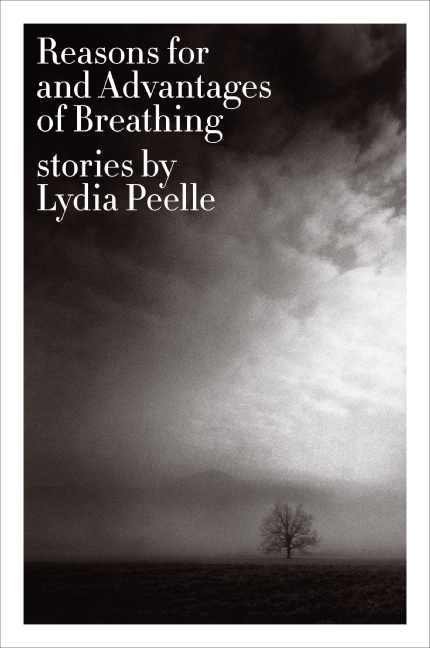
The following is an interview with Lydia Peelle which I found on the Evanston (Illinois) Public Library blog from a year ago January. I recently read her collection of short stories, Reasons for and Advantages of Breathing, which came out from Harper Perennial in 2009, as part of my school work for my essay on nature in fiction. From the very first story, I fell in love with her writing, with her love for her characters and the land they live in, for the animals they share it with. I kept turning to Andrew (I was reading on a long road trip), and saying "This is how I want to write someday." 

I will include excerpts of the interview here. Please visit the EPL blog site for the whole interview. She's my writing soul sister!


Many of your stories seem to deal (if not always explicitly) with history. It seems like in this country we’re constantly in the process of erasing our past. One of the things that struck me so deeply in your stories was this underlying sense of the past continually being paved over with strip malls and Wal-marts. What we end up with is a strange sort of limbo where we have few real reminders of our past, yet we live every day with the legacy of the past. Why do you think we’re so willing and able in this country to eliminate our past? Do you find this to be the case more or less in the South than in New England or other parts of the country?


I was in Ireland once and the old man I was staying with really enjoyed making the point that there was an outhouse on his property that was older than my country.  It is amazing, when you think about it, how young our country actually is – and yes, how much we’ve managed to plunder and pave over and cut down in that short amount of time, but also how recent our past is.  And what a great opportunity that gives us to connect to it. 

Another powerful aspect of your stories deals with people and our growing disconnect from nature and land, soil and animals. ... These issues seem more relevant today than ever. We, as a collective people, have very little connection to the earth, very little in the way of skills or knowledge of how to grow our own food and survive or even to step out into nature and feel at home. What do you think of our current relationship in this country to the natural world?

In two words, not good. We seem to think we exist physically separate of it, forgetting where the basic elements of our lives – food, water, air – come from. We also seem to think we can exist morally and spiritually separate from it, and in a deep way, I think we as a culture are suffering from a spiritual malaise caused by our disconnection from place and land.

For me, the natural world is where I go to seek mystery. I believe that we, as human beings, need mystery in our lives. Because only in mystery can we couch hope. And hope is essential to our survival as individuals, and as a species, and as a world. We need the unknowable places, and yes – the dangerous places – both physical and spiritual.

But modern-day life really beats the mystery out of things. You’ve got to search that much harder for it and find it any way you can – for me that’s out in the woods – or even just in a scrubby open lot behind the grocery store where I can watch a possum lumber up a tree and disappear in a hole. I think we’ve all got to search it out: whether in the woods, or the mountains, or in church, in temple, in private meditation – anywhere you can get in touch with that sense of the unknowable, and be a part of something much bigger than your own life.

Several of the stories in your book feature animals prominently, and in most of these cases the emotional power of the story is derived from a human-animal interaction. Most of the animals featured in your stories are used by humans (as farm machinery, as scientific research tool, as food source, as art, as plaything) to one end or the other, yet somehow transcend this role and end up emotionally, or even spiritually moving the humans who come in contact with them incredibly deeply. What do you think about how our society treats and interacts with animals? Why is it that our bonds with our animals are often deeper than our bonds with other human beings?

I am very interested in our relationship with animals, and, for that reason, I am drawn to the culture of agriculture, where animals are not only companions but partners in work and sources of food. I am interested in the culture (mostly disappearing in this country) where that husbandry is a noble and whole enterprise, rather than the (unsustainable and inhumane) current practice of factory farming and monoculture.

I agree that relationships with animals can be so much purer than the relationships we have with one another. Our domestic animals put ultimate trust in us (they have no choice), so there is great potential there for ultimate betrayal – as Charlie betrays the crippled kid in “Kidding Season.” For me, that signifies all the weight and responsibility of any human relationship. How we relate (or don’t relate) to animals can represent a lot about our failure to communicate well other humans.

I think about the time, ages ago – before agriculture and domestication – that we were much more in tune with all the other living beings we share the earth with. A time when we saw ourselves as part of that larger family, and therefore treated the land, other creatures, and each other with more respect. If we can do whatever we can to get back in touch with the non-human – with the consciousness that surrounds us, right down to the squirrel on the sidewalk – I believe it will make us better humans. It will be a step towards healing the planet we’ve so far ravaged. I also believe it will make us more compassionate about all the human suffering around us. Seeing things as a whole. Not to say we should go out and try to talk to trees. But that we should try to be still, and aware, and in touch with all that surrounds us. It’s a hard thing to do, in this day and age, but ultimately, we’ve got to fundamentally change our view of our place here on earth, get rid of this idea of utter entitlement. Becoming more compassionate towards the fellows we share it with is the first step. [emphasis mine]

Wednesday, October 6, 2010

San Fransisco: Before, After, and After the Earthquake

You history buffs out there, or eclectics like me, might enjoy a comparison of these three videos.

Each video was taken from a trolley traveling down Market Street, toward the San Fransisco Ferry 
riding a SF trolley with friends in 2009
Building. You can see the spire of the ferry building at the end of the road in each of the videos. 

I'm interested in the difference not only in the buildings and attire, but the attitude, expressions, and gestures of the people caught on film

The first video, from 1905, pre-earthquake, is wild with activity. Rumor has it the cameraman hired his friends to drive around like maniacs in front of the trolley to keep the video lively. 

The second video, taken just after the 1906 earthquake, is not surprisingly more sober. But I was intrigued to see families--men, women, and children--walking the streets as if it were any old Sunday morning. 

The third video is modern San Fransisco, 2005, with characteristically busy pedestrians and drivers. Still, some were aware enough to smile and wave at the camera. I laughed out loud when 4:40 into the video one guy pushing his bike across the street waved his hat. It reminded me of a gesture someone from the 1905 video would have made. Word to the wise: listen to the third video on mute. The music is cringe-worthy. Sorry.

First, San Fransisco in 1905, the year before the earthquake and fires that virtually destroyed the city. This video is a chapter of a much longer video. This segment is 4:54 long. (Found via kottke.org) If the embedded video doesn't work, try this link:  http://fora.tv/2008/12/19/Rick_Prelinger_Lost_Landscapes_of_San_Francisco#chapter_12


Second, newly uncovered 1906 footage of the city right after the earthquake and subsequent fires. From 2:30 to 6:00 is the trolley ride down Market Street. The rest contains footage of some of the demolition and clean-up efforts. (Footage from devour via kottke.org)


And here's the third video: a trip down Market Street today... well, 5 years ago. Remember to mute this one. And don't miss the guy at 4:40!

I hope you've enjoyed time traveling with me and seeing how people have lived in and with the great city of San Fransisco. What else did you see in the videos that you thought was interesting?